Parents try their hand at Common Core math
Parents attend math nighttime at Alice Fong Yu Elementary School in San Francisco.
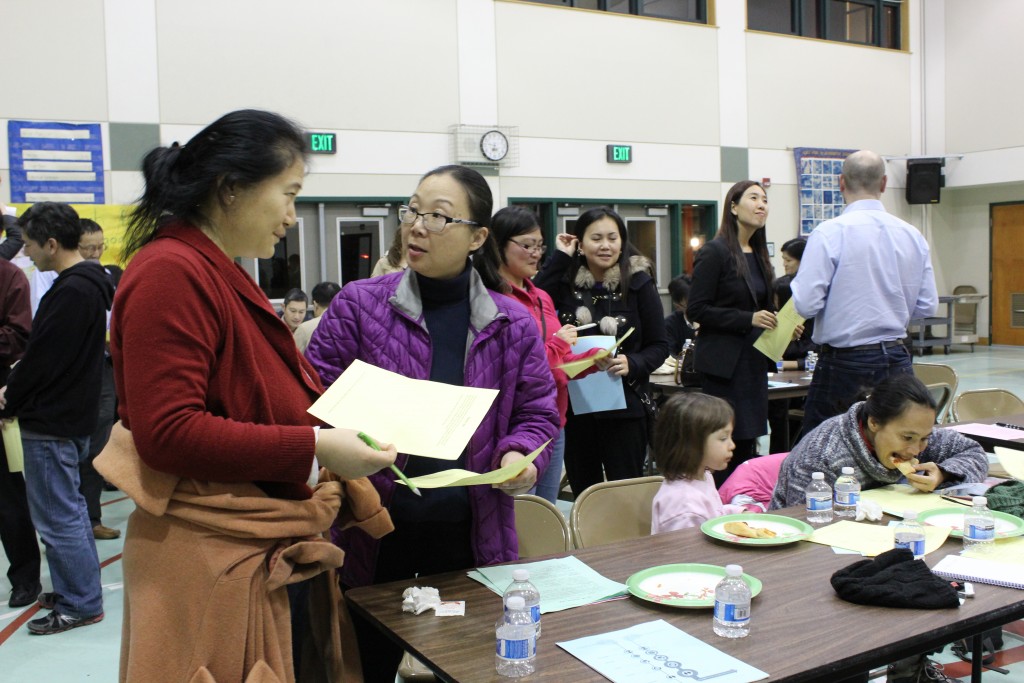
Parents attend math night at Alice Fong Yu Elementary School in San Francisco.
Brandy Frakes, an elementary school instructor at the Aspire University Charter School in Modesto, is tackling ane of the greatest challenges facing educators: building support among bewildered parents for the Common Core standards existence implemented in thousands of California classrooms.
As teachers are discovering, a necessary first stride is helping parents understand what the standards consist of, and how they are concretely shaping how and what their children are learning.
Understanding the Common Core approach to math teaching has been especially challenging for parents, Frakes said. A frequent question she gets from parents is why teaching math based on Common Core standards being implemented in California and 42 other states is a better approach than how their children have been taught in the past.
To answer that, she and i of her fellow teachers organized a parents' math night last fall focused on Mutual Core at the Aspire campus in Modesto. She had parents sit together in groups and work on the same math problems their children grapple with each day.
Common Core supporters say that getting buy-in from parents is essential if the standards are going to have the touch they were intended to have.
"We all desire students to be successful and part of that involves parents understanding and engaging in what happens in the classroom," said Patty Scripter, vice president of teaching for the California State PTA.
In several states there is meaning opposition to the Mutual Core, but the opposite is the case in California. A bound 2022 Public Policy Institute of California poll showed that nigh three quarters of parents back up the Common Core. But the survey also revealed a knowledge gap. Four out of 10 parents said that they had not received any information on the Common Core, and 16 percent said they had received information, merely they needed more.
It is not as if at that place is a shortage of information nigh the Mutual Cadre for interested parents. In fact, parents practice have access to myriad online resources developed by school districts and any number of other organizations. Here are some examples:
- The California Country PTA has produced a "PTA Parents' Guide to Student Success" in several languages.
- Canton offices of education, such every bit the 1 in Orange County, have put together resource guides for parents.
- Individual school districts take as well weighed in with materials similar the parent handbook issued by the Santa Monica-Malibu District and the "Agreement Common Core" materials provided by Sanger Unified in the Primal Valley.
National organizations are besides offering parent-friendly resources, including the "parent roadmaps" to the Mutual Core produced past the Council for Great City Schools.
But teachers similar Frakes and others effectually the state feel there is no substitute for having parents experience Common Core math firsthand. Doing and then shows parents how Common Core math instruction places an emphasis on getting children to solve problems on their own, rather than relying on a teacher to supply the answer. Students are also expected to be able to explain how they came up with their answers – and to realize that at that place are often multiple means to get there.

Piedmont Middle School parents attend Common Core math night.
A contempo math night led by representatives of the Alameda County Role of Education at Piedmont Middle School drew about 70 parents in this flush school in the hills abutting the Oakland Unified Schoolhouse Commune. The parents sat in three different classrooms for 30 minutes each, working in groups to solve samples of problems from 6th- through 8th-grade curriculums, similar to the problems their kids tackle daily.
In one group, parents took on a math problem intended to illustrate the concept of "proportional relationships," which are function of the 8th grade Common Core standards. Parents were given a sheet of paper with a problem that began this mode: "Brandon and Madison use different triangles to determine the slope of the line shown below." Parents were asked to solve the same kind of problem their children will take to solve in the 8th grade – in the space of xv minutes.
Bank check out page six of this Common Cadre workbook to see the math problem that Piedmont parents were asked to solve.
For a Khan Academy online lesson on how to use triangles to make up one's mind the slope of a line, go here.
Charles Robinson, a parent of a 7th grader, would accept liked to have gotten more than concrete tools from the evening session to help his son, who he said has struggled with math bug similar the one he and other parents had grappled with that night. ButRobinson said the session helped convince him that every bit both teachers and students get accustomed to the Common Core standards, math teaching "will be better in the long run" than in the past.
On the other side of the bay, in San Francisco's Dusk Commune, Lily Lei, a parent of a fourth grader and a 5th grader at Alice Fong Yu Elementary School, was one of roughly 60 parents who showed up on a weeknight for a Common Core math lesson and pizza in the school'southward multipurpose room.
Presenters, including onetime classroom teachersfrom the San Francisco Unified School District, had parents work out a 4th-class math trouble involving fractions. Parents were asked to consider what happens when a pitcher strikes out 7 out of eighteen batters. Was that closer to striking out ane/iii or 1/2 of the batters? Instead of the presenters showing them how to solve the problem, they were encouraged to come with solutions within their own grouping, simply as their children are asked to practice in a typical Common Core math lesson. In those groups, they drew pie charts and number lines and used other visual tools to help effigy out the respond.
Parents also got tips for how to assist their children with their math homework. Lei thought the session was helpfulin showing her ways to prompt her kids to break down questions in their math homework. She as well said she felt positive almost the overall objective of Common Core math to develop critical thinking skills in students.
But Lei said she had concerns that Mutual Core requires children to solve math issues in multiple ways, a job that her children discover hard to exercise on their own. She worried that her uncomplicated-age children wouldn't exist able to practise their math homework independently, without guidance and prompting from her. "That's why I question if it'south historic period appropriate," she said, referring to what the Common Core expects of younger children.
To the California Country PTA's Scripter, information technology'due south non surprising that parents are struggling to understand the Common Cadre. "Nosotros are asking them to wrap their heads effectually tons of information," she said.
Modesto teacher Frakes said that at present when parents question the benefits of the Mutual Core, she has a straightforward response. "I invite them to come up into my grade and see it for themselves," she said.
To become more reports like this one, click hither to sign up for EdSource's no-cost daily email on latest developments in education.
lehmanindraviverry.blogspot.com
Source: https://edsource.org/2015/parents-try-their-hand-at-common-core-math/73161
0 Response to "Parents try their hand at Common Core math"
Post a Comment